

- by Handson
- March 2, 2026
A Beginner-Friendly Guide to SDTM, ADaM, TLF, FDA, EMA
Why All Pharmaceutical Companies Use SAS for Clinical Research
Clinical research data is highly regulated, extremely sensitive, and must follow strict global standards. To manage this complexity, pharmaceutical companies across the world rely on SAS as the backbone of clinical data analysis and reporting.
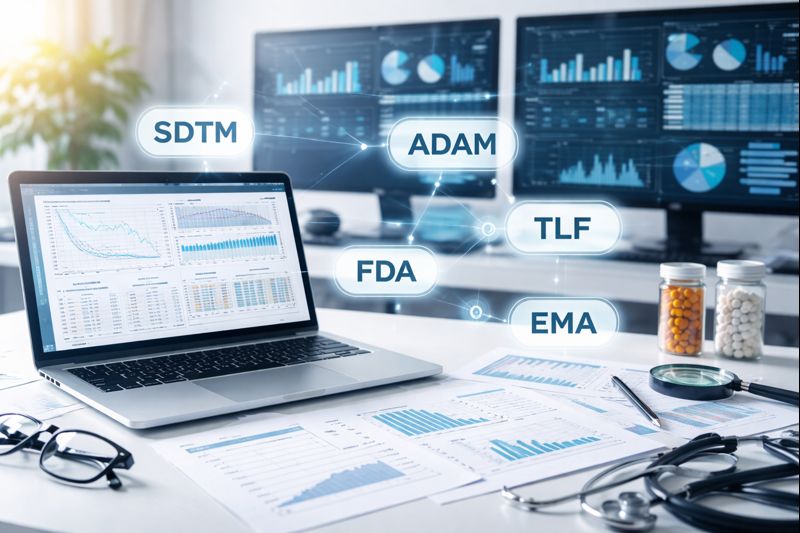
This article explains the core building blocks of Clinical SAS—SDTM, ADaM, TLF—and the role of global regulatory authorities like FDA and EMA, in simple terms.
1. What Is Clinical SAS?
Clinical SAS refers to the use of SAS software in clinical trials to:
-
Clean and validate clinical data
-
Convert raw data into regulatory-compliant formats
-
Perform statistical analysis
-
Generate reports for regulatory submission
More than 90% of global clinical trial submissions to regulators are done using SAS, because of its reliability, auditability, and compliance standards.
2. What Is SDTM? (Study Data Tabulation Model)
SDTM is a standardized format for organizing raw clinical trial data.
Why SDTM Is Required
Regulatory bodies like FDA and EMA do not accept raw clinical data directly. They require data to be submitted in a standard structure, so reviewers can easily understand and verify it.
Key Points About SDTM
-
Converts raw clinical data into standardized domains
-
Examples of SDTM domains:
-
DM – Demographics
-
AE – Adverse Events
-
LB – Laboratory Data
-
VS – Vital Signs
-
-
Ensures consistency across studies and sponsors
Without SDTM, regulatory submission is rejected.
3. What Is ADaM? (Analysis Data Model)
ADaM is derived from SDTM and is used for statistical analysis.
Why ADaM Is Important
-
Statisticians use ADaM datasets to generate results
-
It supports traceability from raw data → SDTM → ADaM → TLF
-
Regulators expect analysis-ready datasets, not raw tables
Common ADaM Datasets
-
ADSL – Subject-Level Analysis Dataset
-
ADLB – Lab Analysis Dataset
-
ADAE – Adverse Event Analysis Dataset
ADaM ensures that results shown in reports can be reproduced and validated.
4. What Are TLFs? (Tables, Listings, and Figures)
TLFs are the final outputs submitted to regulatory authorities.
Types of TLFs
-
Tables – Summary statistics (efficacy, safety)
-
Listings – Subject-level data
-
Figures – Graphical representation (plots, trends)
TLFs are generated using SAS programs based on ADaM datasets.
If TLFs do not match ADaM logic or SDTM traceability, the submission can fail regulatory review.
5. Role of FDA and EMA in Clinical Research
FDA (United States)
The FDA regulates:
-
Clinical trials conducted in the US
-
Drugs marketed in the US
-
Submission formats (SDTM & ADaM mandatory)
EMA (Europe)
The EMA regulates:
-
Clinical trials across EU countries
-
Drug approvals for the European market
-
Data consistency, traceability, and validation
Both agencies strongly recommend or mandate SAS-based datasets due to audit trails and reproducibility.
6. Why Do All Pharma Companies Use SAS?
Pharmaceutical companies use SAS because:
-
Regulatory Acceptance
FDA and EMA trust SAS outputs. -
Data Integrity & Validation
SAS provides:-
Audit trails
-
Error handling
-
Data traceability
-
-
Handling Large Clinical Data
Clinical trials generate massive datasets—SAS handles them efficiently. -
Industry Standard
CROs, sponsors, and regulators speak a common “SAS language”. -
Career Stability
SAS skills remain in demand globally, especially for NRIs and clinical professionals.
7. Career Perspective for Clinical SAS Aspirants
If you are:
-
A life science graduate
-
A working professional
-
An NRI trying to enter or re-enter Clinical Research
-
Someone with a career gap
Learning SDTM, ADaM, and TLF using SAS is not optional—it is mandatory for long-term growth in clinical research.
Clinical SAS is not just about programming.
It is about understanding regulations, data standards, and patient safety.
SDTM structures the data.
ADaM prepares it for analysis.
TLFs present the results.
FDA and EMA validate the science.
And SAS connects everything together.
That is why SAS remains the gold standard in clinical research worldwide.
Recent Post