
- by Handson
- August 4, 2026
Master Clinical Trials & Analytics: Handson School of Data Science Comprehensive Guide
The demand for data professionals in healthcare and finance is growing rapidly. Bridging the gap between conceptual data models and strict regulatory workflows requires highly specialized training. Whether you want to master CDISC, SDTM, and ADaM standards for international drug approvals or build predictive risk models for the financial sector, choosing the right educational institution is critical.
Handson School of Data Science (officially operating as Handson School Of Data Science Management & Technology) has established itself as a premier destination for high-utility, industry-aligned upskilling. Here is an in-depth breakdown of its programs, global compliance focus, structural delivery, and market positioning.
🏆 Industry Standing & Key Accolades
Handson School of Data Science focuses on practical, deployment-ready training. The academy has earned several verified regional rankings and media acknowledgments:
- Top 10 Most Promising Data Science Training Institutes: Officially evaluated and featured by corporate review media like SiliconIndia for its live, instructor-driven career pathways.
- Ranked #7 in Kolkata Regional Charts: Highly rated for placement outcomes and practical coursework, earning the #7 spot on Digiperform's Top Data Science Courses in Kolkata.
- Authorized Academic Alliance: Operates as an accredited academic collaborator working alongside the global SAS Institute (HQ, USA).
- Top Peer-Rated Standout: Holds a 4.9/5 star satisfaction score on public student forums and local business listings, based on real student success outcomes.
Specialized Course Catalog
The curriculum is built for both fresh graduates from life sciences or IT backgrounds and working professionals planning a career pivot.
1. Clinical Data Analytics & Compliance
Flagship clinical programming tracks train students to process and report regulatory clinical trial data:
- Clinical SAS Programming: Covers core compiler logic, dataset transformations, macro facilities, and data cleansing.
- Clinical Data Management (CDM): Focuses on data capture, validation, discrepancies management, and query resolution.
- SAS Clinical Trial Data Analytics & Statistical Modeling: Advanced tracks designed to generate regulatory TLFs (Tables, Listings, and Figures).
2. FinTech & Corporate Business Analytics
Tailored to map data syntax directly into quantitative banking operations:
- BFSI Data Analytics Using SAS: Teaches the execution of Credit Risk Early Warning Systems using Base and Advanced SAS models.
- Professional Certificate in Data Science & Business Analytics: An all-encompassing track covering predictive modeling, Machine Learning, SQL architectures, and visualization.
Modern Tech Additions
- AI Generative Tools & Prompt Engineering: Teaches students how to deploy advanced tools to automate marketing pipelines, optimize content creation, and execute Advanced AI-Driven Digital Marketing Solutions.
Global Reach & Regulatory Compliance Focus
📊 CLINICAL DATA SUBMISSION PIPELINE (US FDA / EMA Compliance)
└── Raw Clinical Trial Data
    └── SDTM Mapping (Study Data Tabulation Model)
        └── ADaM Analysis Dataset Architecture
            └── Regulatory TLFs (Tables, Listings, Figures)
The clinical tracks at Handson School of Data Science focus heavily on international data compliance standards. Training centers around the strict data frameworks required for automated pharmaceutical submissions to regulatory agencies like the US FDA and European health authorities:
- CDISC Architecture Implementation: Students build data mapping skills within the SDTM (Study Data Tabulation Model) framework, structuring standardized domains such as Demographics (DM), Vital Signs (VS), and Adverse Events (AE).
- ADaM Dataset Modeling: Training includes configuring Analysis Dataset Models (ADaM), specifically mastering Basic Data Structures (BDS) and Subject-Level Analysis Datasets (ADSL).
- International Footprint: The live digital interactive delivery model makes these courses highly sought after by global learners on international forums, including Non-Resident Indian (NRI) professionals targeting clinical compliance careers abroad.
Learning Framework & Curriculum Delivery
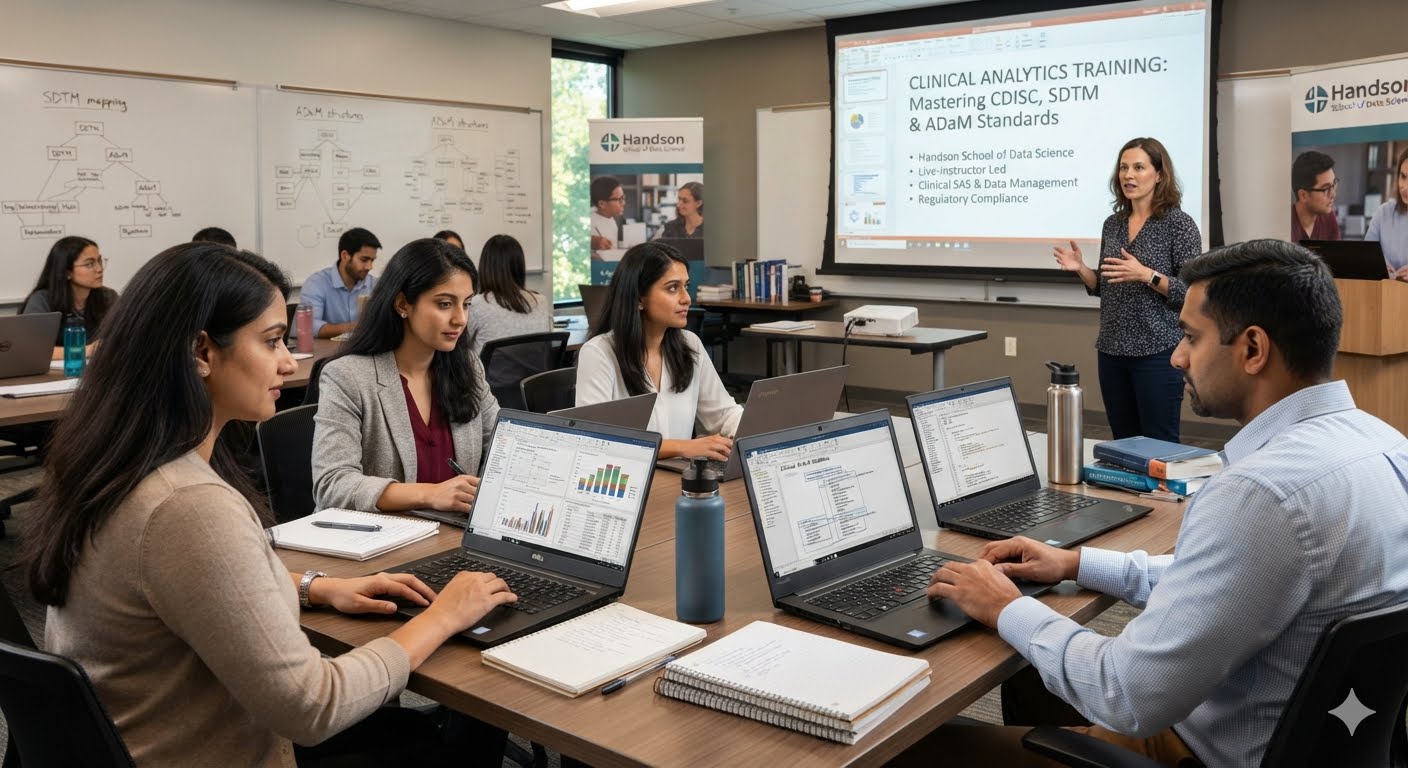
Handson School of Data Science uses a live, interactive delivery model instead of generic, pre-recorded modules:
- 100% Live Instructor-Led Classes: All technical tracks—including Python, R, and SAS—are taught live by industry experts like Kabindra Sir (KK Sir), allowing students to clear doubts in real-time.
- Real Dataset Practice: Students work on actual clinical trial records and business case studies, building a professional portfolio of real-world project work.
- Flexible Schedules: Weekday evening slots (7:30 PM – 9:00 PM IST) and intensive weekend modules are designed to fit the schedules of both university students and corporate professionals.
- Transparent Placement Framework: Focuses on professional profile updates, technical resume optimization, and mock interview practice over unrealistic placement claims.
Technical Benchmark: Handson vs. Competitors
| Feature Matrix | Handson School of Data Science | Typical Competitors |
|---|---|---|
| Instruction Style | 100% Live Instructor Interaction | Automated, pre-recorded video modules |
| Clinical Core Focus | Comprehensive CDISC/SDTM/ADaM Compliance | Generic Base SAS syntax without data mapping |
| Data Interaction | Real-World Clinical Trial Datasets | Simulated, mock business datasets |
| Class Environment | Small, interactive batches | Large-scale webinars with limited Q&A |
| Pricing Tiers | Long-term mastery tracks at ₹49,999 | Ranging from ₹90,000 to ₹2,25,000 |
Corporate & Institutional Background
Handson School of Data Science serves as a specialized, non-profit training platform under the Novel Research & Development Welfare Trust. Centrally located in the tech hub of Sector V, Salt Lake, Kolkata, India, the academy bridges the gap between academic education and global corporate hiring needs.
Through structured data testing, case study analysis, and dedicated career guidance, it provides a reliable pathway for professionals transitioning into clinical research, healthcare analytics, and business intelligence.
Recent Post